


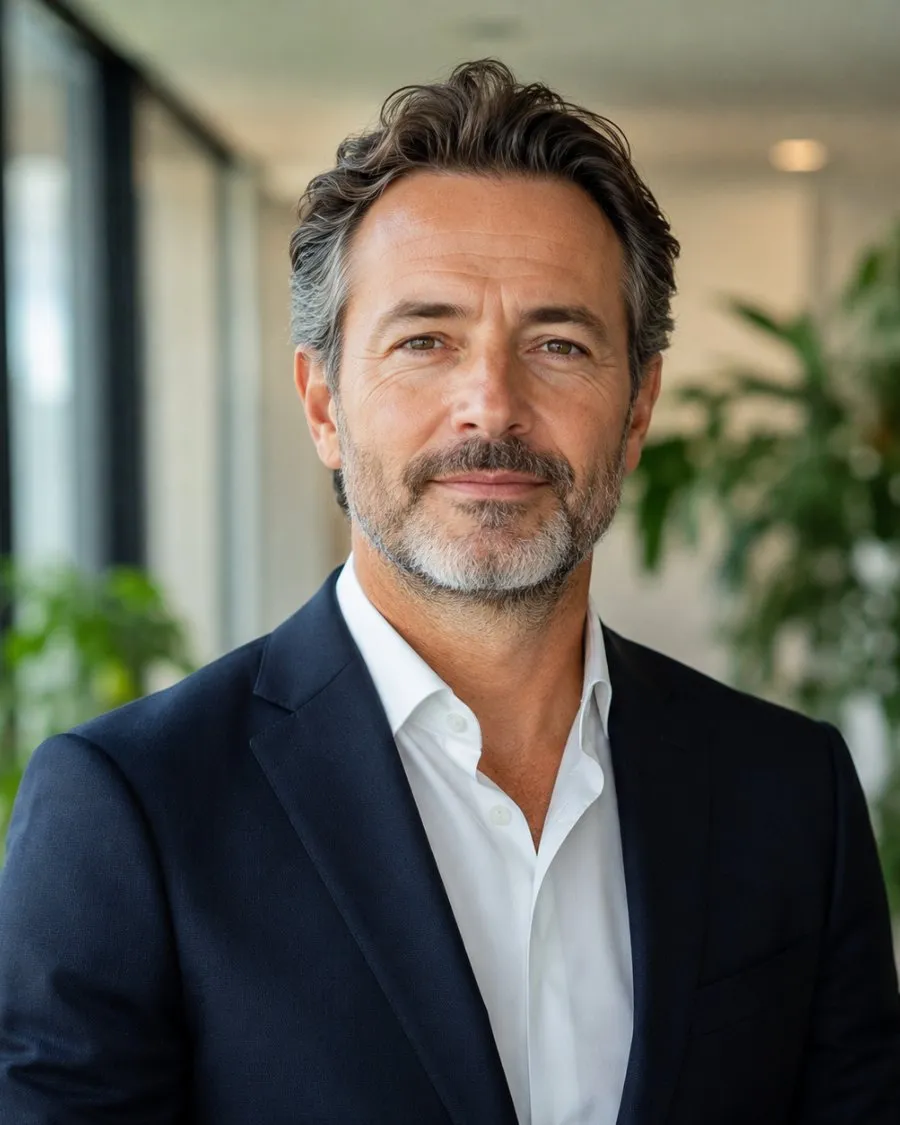
Elke Vermeer
Chief Executive
Ran grid connections at a Dutch DSO for eleven years before this.
About Greenvia
Queue positions, curtailment models, grid studies, twenty-five years of availability reporting. Somebody has to do it, and the megawatts only exist afterwards.

Approach
Greenvia originates, builds and operates renewable assets across nine European markets. We are not a fund and not a consultancy — we carry the asset.

We start at the interconnection queue and the resource data, in that order. A site that cannot connect is a press release, not a project, and the difference is usually visible in the first fortnight.
It cost us a 400 MW site in Andalucía that everyone else was still bidding on.
We hold assets through operation, so the twenty-year cost of a decision lands on our own balance sheet rather than on the buyer's. It changes what you specify, and it changes who you argue with at procurement.
It cost us the fee on eleven sales we could have taken at commissioning.
Offtake, curtailment and basis risk are priced before financial close, against measured data rather than a forecast we commissioned. Nothing in the model depends on the weather being kind.
It cost us two competitive bids to developers who priced the weather kindly.
Generation, availability and carbon are reported monthly against the case each asset was underwritten on — including the years it missed, and the two assets that have never made theirs.
It cost us a client who wanted the bad year taken out of the deck.
Fourteen years
2011
The array took four months to install and nineteen to permit. Everything we do about consent scheduling comes from that ratio.
2015
The resource was better than modelled and the network could not take it. We started pricing constraint before generation.
2018
Holding them changed every design decision, because the twenty-year maintenance case became ours instead of somebody else's problem.
2021
Not next to the generation, where it is easy to explain, but where the network actually hurts. The first system paid back four years early.
2024
Eighty-four assets across nine markets, reported monthly against the case each one was underwritten on.
What we are actually for
2031
11 years
The average time from first site visit to first megawatt. Most of it is paperwork, and none of it photographs well.
Zero
Sites we have pushed through planning against the settled objection of the people who live beside them. That is not a moral position — it is how an asset survives twenty-five years.
25 years
How long we hold what we build. Which is why the case has to be right on the day it is written, not on the day it is sold.
Who carries it
Chief Executive
Ran grid connections at a Dutch DSO for eleven years before this.
Development
Originated 1.4 GW of Iberian solar, and walked away from twice that.

Operations
Twenty years of turbine availability data, and strong opinions about all of it.

Finance
Structures the offtake, and is the reason nothing here depends on a good year.
Commitments
Each one has cost us a project. That is roughly how we know they are commitments.
 Published performance
 Land back better
 Local first on labour
 No greenwash in the deck
Working here
No press office, no growth team. If a role is open it is because there is a project waiting on it.
Send us the constraint. We will tell you within a fortnight whether it is buildable and what it would take.